The Inclusive Futures Method
This five-phase course develops a practical way to move from a difficult futures issue to an ethical, coherent and intergenerational pathway. The phases are used as one integrated method: each phase strengthens the next, and the final synthesis can reveal where a further cycle is needed.
Learning pathway
- Unique Uplift — create distinct, ambitious strategies for a hopeful future, including sustainability and social impact.
- Universal Interest — establish shared values that support trust and cooperation.
- Uniting Possibilities — use diversity as a strength for community uplift.
- Unaligned Factors — identify and realign actions, incentives and systems that do not support the vision.
- Inclusive Synthesis — integrate all phases into a cohesive, sustainable whole that works towards intergenerational futures.
A connected case across the course
You will work with a fictitious Australian coastal city facing rising infrastructure costs, housing pressure, ecological stress and disagreement about the pace of adaptation. The case is deliberately unresolved. Your task is to use each IFM phase to improve the quality of the decision rather than jump to a predetermined answer.
What you will produce
- a clear statement of the futures issue and the people, places and generations affected;
- three genuinely different hopeful strategies;
- a shared-values compact and a diversity map;
- an alignment audit covering policy, funding, behaviour and time horizons; and
- a one-page Inclusive Synthesis pathway with commitments, safeguards and review points.
Creator and source
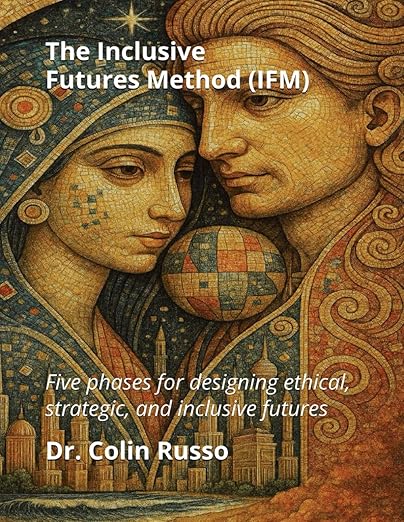
The Inclusive Futures Method was created by Dr Colin Russo, Futurist and CEO at Engaging Futures Brisbane, drawing on more than three decades advising senior leaders in government and community sectors.
Book foundation: The Inclusive Futures Method by Dr Colin Russo.
Curriculum
- 2 Sections
- 5 Lessons
- 5 Hours
- CurriculumWelcome to The Inclusive Futures Method. Five interactive lessons and five knowledge checks teach the five connected phases developed by Dr Colin Russo and presented in The Inclusive Futures Method book: Unique Uplift, Universal Interest, Uniting Possibilities, Unaligned Factors and Inclusive Synthesis. Apply each phase to a real futures challenge, then continue with the separate Vinculum Method, TRAM, Futures Thinking Kite and SELECTIONS courses available through All Courses.10
- 1.1Lesson 1: Unique Uplift – Distinct Ambitious Futures30 Minutes
- 1.2Quiz 1: Apply Unique Uplift10 Minutes6 Questions
- 1.3Lesson 2: Universal Interest – Shared Values and Trust30 Minutes
- 1.4Quiz 2: Apply Universal Interest30 Minutes4 Questions
- 1.5Lesson 3: Uniting Possibilities – Diversity as Strength30 Minutes
- 1.6Quiz 3: Apply Uniting Possibilities4 Questions
- 1.7Lesson 4: Unaligned Factors – Realign Action with Vision30 Minutes
- 1.8Quiz 4: Apply Unaligned Factors1 Hour6 Questions
- 1.9Lesson 5: Inclusive Synthesis – Integrate the Five Phases30 Minutes
- 1.10Quiz 5: Apply Inclusive Synthesis5 Questions
- Enrolled Learner Resources0

Requirements
- Reliable internet access and a computer, tablet or smartphone.
- A valid email address for registration and course communication.
- Time to complete five interactive lessons and five knowledge checks at your own pace.
- A real decision, organisation, community or futures issue to use as an application case.
- An open, critical and ethical mindset, with a willingness to test assumptions.
- Commitment to reflection, journalling and practical application between lessons.
- Willingness to consider diverse perspectives and shared values.
- No specialist software is required; a current web browser is sufficient.
- No prior qualification in futures thinking is required.
Features
- Five connected IFM phases: Unique Uplift, Universal Interest, Uniting Possibilities, Unaligned Factors and Inclusive Synthesis.
- Four specialised companion courses—Vinculum Method, TRAM, Futures Thinking Kite and SELECTIONS—are available separately through All Courses.
- Interactive exercises, reflection prompts and five phase knowledge checks support practical application.
- Self-paced learning through five IFM phase lessons and five knowledge checks, with application to a real futures challenge.
Target audiences
- Senior executives and public-sector leaders making long-term decisions.
- Strategy, policy, planning and foresight professionals.
- Community, not-for-profit and social-impact leaders.
- Educators, facilitators, researchers and program designers.
- Professionals leading organisational change, innovation or sustainability.
- Entrepreneurs and advisers assessing long-term opportunities and risks.
- Teams seeking stronger shared values, trust and cooperation.
- Students and emerging leaders developing futures capability.
- Organisations working across sustainability, social impact and intergenerational outcomes.
- Consultants supporting complex stakeholder and systems challenges.
- Individuals navigating major decisions or transitions.
- Anyone committed to ethical, inclusive and sustainable futures.